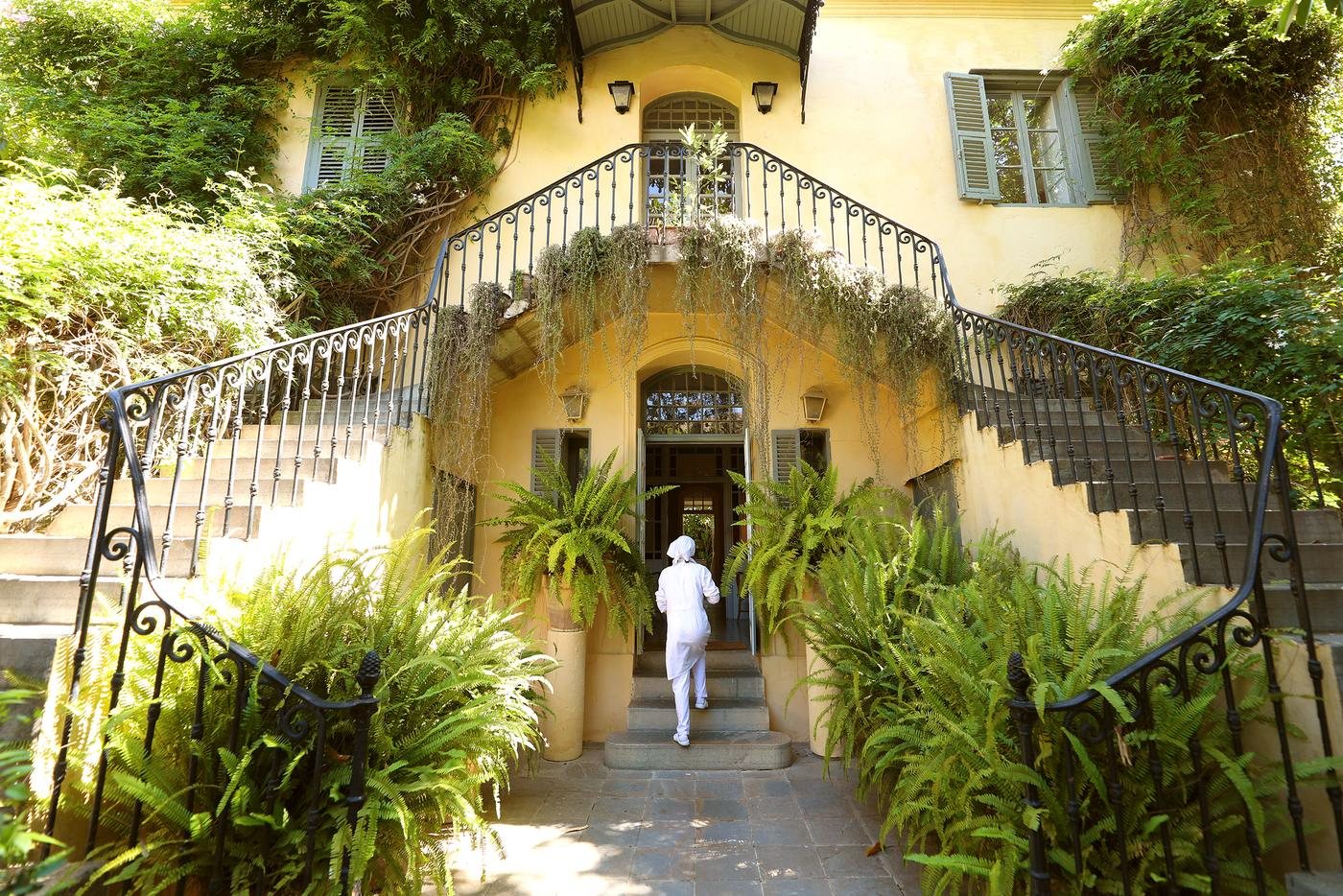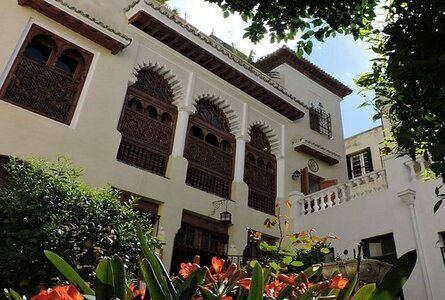
Before Dar-Tus took guests, it was a family home in Dar Baroud, in Tangier’s old medina. A family from Fez lived there in the 1940s. There were weddings, parties and births, enough occasions for the house to acquire a nickname: the House of Happiness. By the time Marie and Christophe found it, it had stood empty for years. They restored it as a place where families could stay together, with a children’s corner off the patio and a terrace looking towards the Strait.
There are grander places to sleep in Tangier, but Dar-Tus gets at something that can disappear when a home becomes a hotel. A bedroom may be where you leave your bag. The patio is where you find everyone else.
A house with its own centre of gravity
A riad begins with an idea about where life should happen. The street belongs to the city. Beyond the door, the house has its own centre: a garden, light from above, rooms arranged around a private world.
The word comes from the Arabic for gardens. In its stricter architectural meaning, a riad is organised around an interior garden, traditionally divided into four parts. A dar is a house; in the familiar courtyard form, its centre may be paved rather than planted. Tourism has stretched “riad” into a convenient description for almost any intimate Moroccan guesthouse. A roof terrace, lantern collection and plunge pool can help sell a room, but do not settle the architectural question.
The garden tradition has Persian roots and developed through the Islamic world and al-Andalus. Moroccan evidence reaches back at least to the early twelfth-century Almoravid palace of Ali ibn Yusuf in Marrakech. The wider courtyard-house tradition has a longer Mediterranean history: the riad brings particular garden principles into that inward-looking domestic world. Privacy, shade and the organisation of household life are part of its purpose.
This gives Tangier’s houses a more interesting test than how old their plaster looks. What survives of the original plan? Who restored it, and which craftspeople did the work? Does the courtyard still organise the house, or has it become a decorative space between bedrooms? A contemporary restoration can respect those principles. An elderly building can lose them.
The old hands: houses that helped define the stay
Dar Nour is a natural place to begin the established addresses. Its Kasbah setting, sea-facing outlook and individually furnished rooms offer a version of Tangier assembled through objects and personal choices. The house describes itself as the city’s oldest guesthouse. Dar Sultan, a few lanes away in the Kasbah, describes itself as the first to receive official approval.
Dar Sultan makes a virtue of colour and accumulation. Its owners describe a roughly three-century-old house, restored by master craftspeople from Fes and Marrakech, with seven differently decorated bedrooms around a patio. Objects gathered in Tetouan, the Rif and further afield give the interiors their exuberance. Its appeal is the pleasure of a house allowed to have opinions.
At La Maison Blanche, the restoration story is tied to a Tangerino: Aziz Begdouri. The hotel’s account describes six years of work, including decorative plaster and handmade tiles. His background as a city guide adds another reason to look closely: a host can provide an understanding of the neighbourhood that no bedroom photograph conveys. The building’s claimed fourteenth-century origins remain an attribution from the hotel.
When restraint is not the point
Nord-Pinus Tanger supplies the more theatrical register: bronze beds, precious fabrics, marble and handmade tiles, with terraces looking across the Strait. The hotel describes its home as an eighteenth-century palace. Here the attraction is the combination of small scale and expansive outlook: a stay built around individual rooms and the drama of Tangier’s position above the water.
It is also worth knowing that the terrace experience need not require a room reservation. The hotel currently advertises a walk-in bar and restaurant bookings. Opening arrangements should be checked directly before going. An aperitif on the terrace gives you the same view across the Strait.

Smaller bills, substantial character
For a simpler medina stay, try Dar Bargach. Its rooms face a tiled patio with a small pool. Ask for the total for your dates, including breakfast and taxes.
Dar Yasmine provides a useful published reference point. Its own tariff page lists standard doubles from €90 in low season, including breakfast, with local taxes additional. Check the rate for your dates with the house. Opposite the Great Mosque, it also raises the practical questions that make a guide useful: which room, what outlook, how many stairs, and how comfortable will the stay be in winter?
A fresh expression of the house
Dar Elif offers a contemporary restoration in the Kasbah. Its own description credits Tangier craftspeople; the interiors include a Moroccan salon, library corner and a central skylight. It is a useful house through which to ask what a modern guesthouse can retain of traditional spatial ideas. Its star-patterned skylight brings daylight into the middle of the house.
Beyond Tangier’s walls
For the country chapter, Berbari is a promising change of rhythm. The guesthouse places itself seven kilometres south of Asilah, in the village of Medchar Ghanem, with natural materials, a garden, patio and fireplace. After the close quarters of the medina, here there’s room for the garden to spread out around the house.

Back in Dar Baroud, the terrace at Dar-Tus gives you the view everyone comes to Tangier for. The patio downstairs explains why the house was worth saving.